People come to us with all kinds of headaches. Some have had them since high school. Some noticed them after a fender bender on I-485 or a hard fall. Some get a dull ache at the base of the skull every afternoon after hours at a laptop.
Not every headache has anything to do with the neck, and not every headache belongs in a chiropractic office first. For some people, though, the top of the neck is part of the story. Here is how we sort that out.


Can a headache come from your neck?
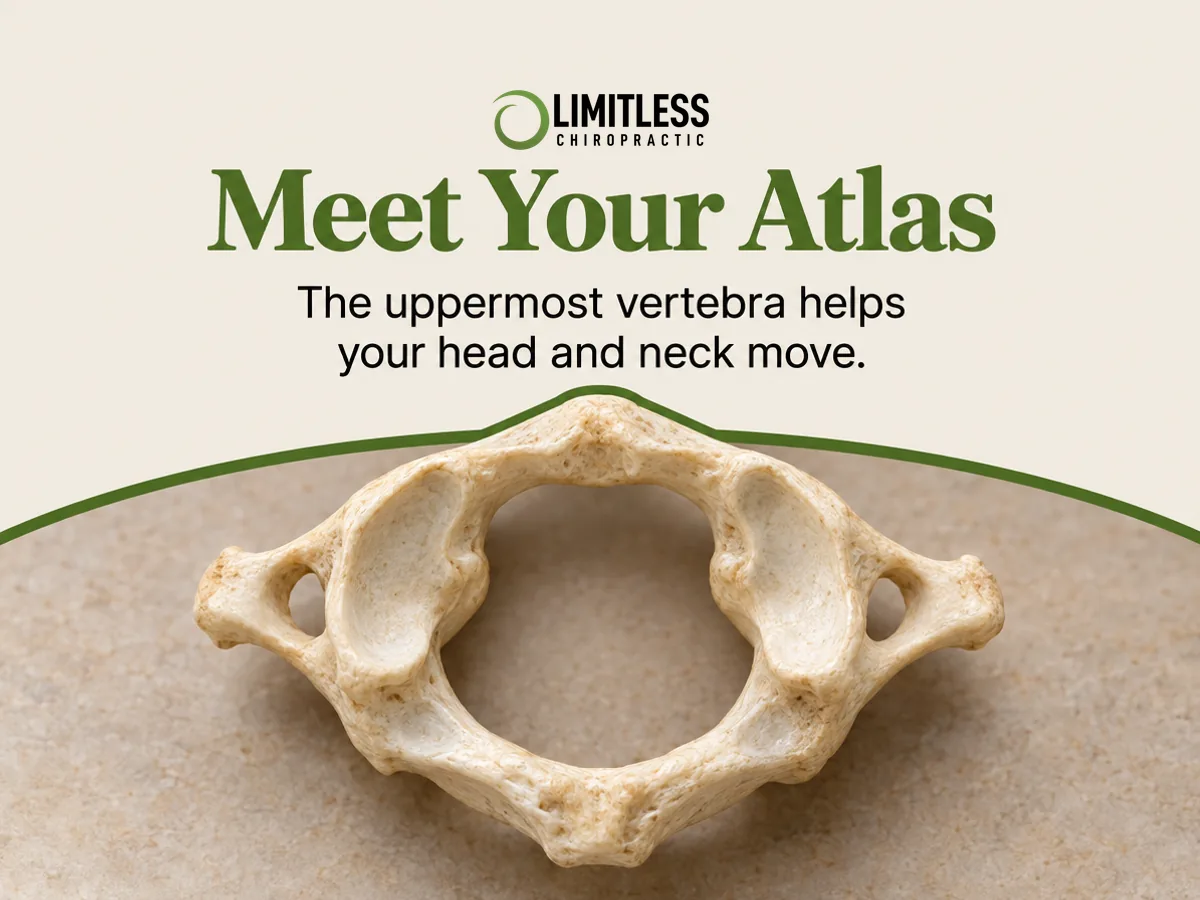
Yes, some can. The top two bones in your neck, the atlas (C1) and the axis (C2), sit right under the skull. The joints, muscles, and nerves around them also supply sensation to parts of the head, so when that area is irritated or not moving well, the pain can be felt in the head rather than the neck.
Doctors call this a cervicogenic headache. The International Classification of Headache Disorders (ICHD-3), published by the International Headache Society, describes it as a headache caused by a disorder of the cervical spine, often but not always with neck pain. It is a recognized type of headache, but it is only one of many.
Clues that the neck may be involved
- The headache starts at the back of the head or the base of the skull and spreads forward
- It tends to stay on one side
- Certain neck positions or movements bring it on or make it worse
- Your neck feels stiff or does not turn as far as it used to
- It began or changed after a car accident, a fall, or a sports injury
None of these prove the neck is the cause. They are reasons to look.
How neck-related headaches compare with other common types
Migraines and tension-type headaches can overlap with neck pain, which is why the pattern matters as much as the location.
| Neck-related (cervicogenic) | Tension-type | Migraine | |
|---|---|---|---|
| Where it is felt | Usually one side, starting at the back of the head | Both sides, like a band around the head | Often one side, sometimes behind the eye |
| How it feels | A steady ache tied to neck movement or posture | Pressing or tightening, mild to moderate | Throbbing, moderate to severe |
| Other signs | Neck stiffness, reduced turning | Usually none | Nausea, sensitivity to light and sound |
| What makes it worse | Certain neck positions or sustained postures | Stress, poor sleep, long days | Routine activity, plus personal triggers |
Many people have more than one type, and that is part of what a careful history sorts out.
What we check at Limitless
At our Ballantyne office, the first visit is split across two days, and both are about finding out whether the upper neck is part of your headache pattern before anything is recommended.
| Step | What happens | Why it matters for headaches |
|---|---|---|
| Consultation (day one) | Your headache history: when they started, how often they come, what triggers them, past injuries, and your goals | Patterns point toward or away from the neck |
| Three evaluations (day one) | Thermography, a MyoVision muscle scan, and posture analysis | Shows temperature patterns, muscle tension, and alignment along the spine |
| 3D CBCT imaging, only if needed (day one) | Done only when the evaluations point to the upper neck | Shows the direction and degree of any misalignment at the top of the neck |
| Report of findings (day two) | A walk-through of what we found and what we recommend | You understand the plan before you agree to it |
| First correction (day two) | A gentle, precise correction, if one is needed | No twisting and no forceful cracking of the neck |
Dr. Tim leads our upper cervical care. If you want the step-by-step version, see our guide to the first two visits.
Warning signs that need medical care first
Get emergency care right away for:
- A sudden, severe headache, often described as the worst of your life
- A headache with fever and a stiff neck
- Weakness, numbness, confusion, trouble speaking, or loss of vision
- A headache after a significant blow to the head
- Headaches that keep getting worse along with other symptoms, like unexplained weight loss
If anything like this comes up during your visit, we will send you to the right place before any care with us.
What we will not tell you
You will not hear us promise to cure your migraines. We will not tell you every headache comes from the atlas, or that everyone needs imaging. Headaches have many causes, and some are better handled by a neurologist, a primary care doctor, a dentist, or an eye doctor. Part of our job is figuring out whether our upper cervical care is a good fit for you, and telling you plainly if it is not.
If upper cervical care is a fit
When the exam and imaging point to the upper neck, care starts with a correction, and follow-up visits check whether it is holding. We track how often your headaches come and how strong they are throughout care, which gives a clearer picture than memory alone. If you are new to this approach, here is what upper cervical chiropractic is and how it differs from other chiropractic care.
Habits that can feed neck-related headaches
- Long stretches looking down at a phone or laptop
- A monitor set too low or off to one side
- Sleeping on your stomach with your head turned
- Clenching your jaw when stressed
- Skipping meals or not drinking enough water
Raising your screen to eye level and taking short breaks to move your neck can be a useful complement to care. If stiffness is the bigger problem than the headaches, our neck pain care page covers that side.
FAQ
Can a chiropractor help with headaches?
For some headaches, yes, especially when the source is in the upper neck. For others, no. An exam is how we find out which group you are in.
Can a chiropractor help with migraines?
Some people with migraines find their neck plays a role in how often they get them. Others do not. We will tell you honestly what your exam suggests.
Do I need imaging?
Not always. 3D imaging is taken only when the day one evaluations suggest it will guide your care.
Should I stop my headache medication?
No. Keep following your doctor's guidance, and tell us what you take.
Do I need a referral?
No. You can book directly at our office in Ballantyne Village.
If headaches are getting in the way of your life, learn more about our headache and migraine care in Charlotte, or call (704) 765-0454 to book a first visit.
Keep reading
Have a question about your own care? Contact our Ballantyne office or call (704) 765-0454.