If you picture chiropractic as a quick crack and out the door, an upper cervical first visit will feel different. Most of the appointment goes to understanding how your head and upper neck are sitting and moving. A correction, if one happens at all that day, comes after the doctor has a clear picture.
Here is how the visit is usually organized at our Ballantyne office, how to get ready, and what you should know before you walk back out to the parking lot.


The visit at a glance
| Part of the visit | What it covers |
|---|---|
| Health history | When symptoms started, injuries and accidents, past care, scans you already have, and what you want to get back to |
| Exam | Neurological and orthopedic tests focused on the top of the spine |
| Imaging and analysis | Precise views of the upper neck when your case calls for them |
| Report of findings | The doctor explains, in everyday words, what the exam and images showed |
| First correction | Only once the analysis supports it and you have agreed |
| Plan | When you come back, what to do at home, and which symptoms mean you should call |
Getting ready
- Bring any neck X-rays, MRI reports, or patient portal logins from past workups.
- Write down your medications and any chiropractic, physical therapy, or injections you have had.
- Dress comfortably. Loose layers make the exam easier.
- Jot down your three most bothersome symptoms and what tends to ease or aggravate each one.
- Block off more time than a routine follow-up would need.
- Leave a cushion for I-485 or Providence Road traffic so you are not rushed at check-in.
How the first hour usually goes

You will start by talking through your history: how things began, earlier adjustments, headaches, any dizziness, how you sleep, and how many hours you spend driving or at a desk. The physical exam comes next. Depending on what the doctor finds, imaging may be done the same day or scheduled for a follow-up. Our 3D imaging and thermography page explains the tools used.
Before anyone adjusts you, there should be a report of findings. A useful test: can you sum up the main finding in a sentence? If not, ask the doctor to walk through it again. Agreeing to care should mean you actually understand it.
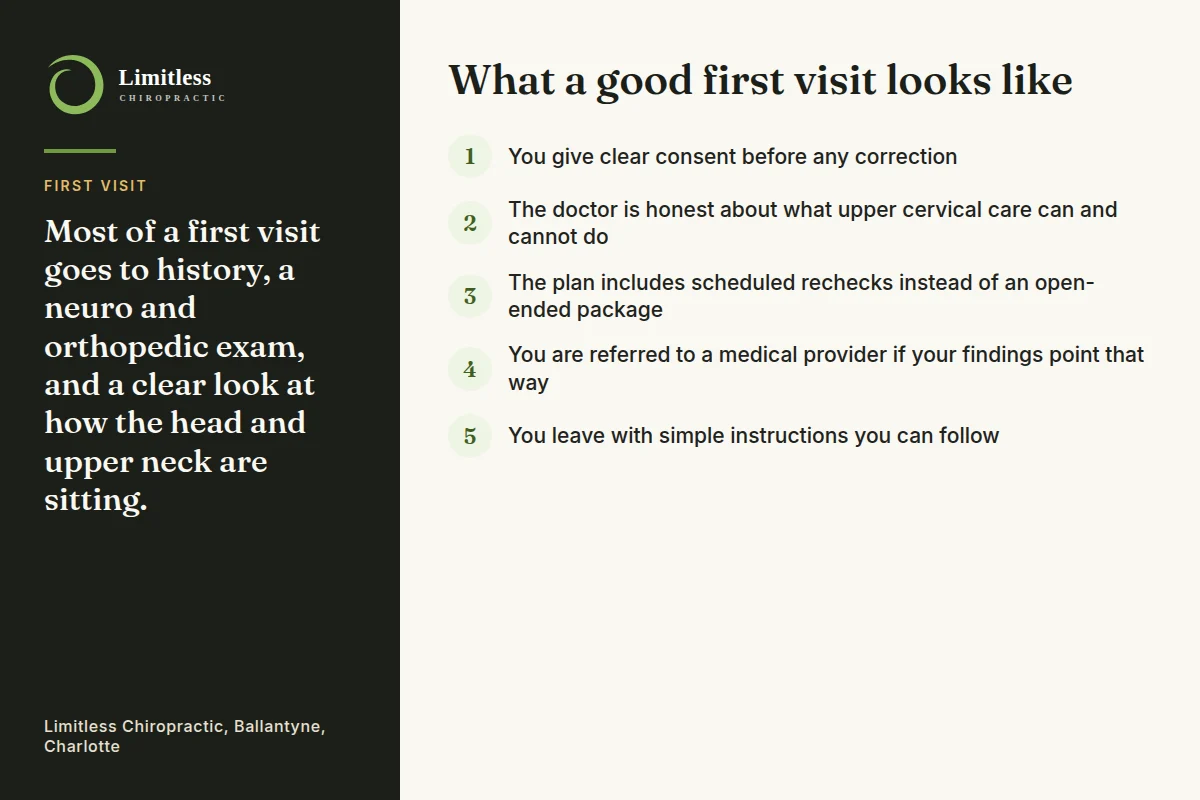
What a good first visit looks like
- You give clear consent before any correction
- The doctor is honest about what upper cervical care can and cannot do
- The plan includes scheduled rechecks instead of an open-ended package
- You are referred to a medical provider if your findings point that way
- You leave with simple instructions you can follow
Imaging day and correction day
Some upper cervical offices finish all imaging and analysis before the first correction, sometimes over two appointments. Others fit more into one longer visit. Neither is automatically better. What matters is that imaging is used to plan a precise correction and that you understand the results before agreeing to anything.
Already had neck films taken by a medical provider? Bring them. Sometimes they are enough, and sometimes the technique still needs its own specific views. The doctor will explain which applies to you.
After the first correction
Many offices ask you to rest for a few minutes after a correction and then recheck posture or neurological findings. Instructions afterward vary and might cover activity, sleeping position, or when to call. Ask for them in writing.
A neck that feels very different the next morning does not prove the care worked, and a neck that feels the same does not prove it failed. Rechecks exist to measure change over weeks. Ask which measures the doctor will track besides how you feel.
Why Charlotte necks get stuck
Long commutes, desk work, and hours on a phone show up again and again in the histories we hear. Plenty of stiff necks get better with general care or simple changes at work. A careful look at how the head sits on the neck makes the most sense when symptoms keep coming back after other approaches.
Questions people are nervous to ask
People often wonder about the popping sound, imaging fees, and whether they will be pushed into a long commitment. Ask about costs before imaging. Ask how many visits an early plan usually includes and what happens if progress stalls. A clear answer is a good sign. A vague bundle is a reason to keep looking.
When care stops for the day
A sudden severe headache unlike any you have had, a drooping face, slurred speech, new weakness in an arm or leg, loss of bowel or bladder control, fever with a stiff neck, or a recent serious injury all need urgent medical attention. A responsible chiropractor will stop and send you to the right place.
Before you book a second visit
- Can you explain what the doctor found?
- Were you adjusted, and do you know why or why not?
- What should you watch for before the recheck?
- When is the recheck and what will be measured?
- What would lead the doctor to refer you elsewhere?
Bringing a spouse or friend to the report of findings helps. There is a lot of new information in a first visit, and a second listener makes it easier to remember the details later.
When you are ready, you can learn more about seeing an upper cervical chiropractor in Charlotte or find hours and directions for Limitless, your chiropractor in Charlotte.
Have a question about your own care? Contact our Ballantyne office or call (704) 765-0454.