
Fewer than 1,200 chiropractors worldwide practice upper cervical chiropractic care. Only a small fraction of those hold certified instructor status in the Knee Chest Upper Cervical technique. Dr. Tim Hartman is one of them.
At Limitless Chiropractic in Charlotte, NC, Dr. Tim doesn’t just perform this specialized adjustment. He teaches it to other chiropractors around the globe. His training lineage traces directly back to the founder of the technique, spanning nearly a century of hands-on expertise.
This article explains what the Knee Chest Upper Cervical technique is, how it works, what conditions it helps, and why Dr. Tim’s credentials make him one of the most qualified practitioners in the field.
What Is the Knee Chest Upper Cervical Technique?
The Knee Chest Upper Cervical technique is a specialized chiropractic method. It targets the two topmost bones in your spine: the atlas (C1) and the axis (C2). These small but critical vertebrae sit right beneath your skull. They protect the brainstem, the part of your nervous system that controls communication between your brain and every organ, muscle, and tissue in your body.
Even a slight shift in these bones can put pressure on the brainstem. That pressure disrupts nerve signals and can trigger a wide range of health problems, from chronic headaches to dizziness to fatigue.
The technique gets its name from the patient’s position during the adjustment. You kneel on a padded table and rest your chest forward on a cushioned support. This position gives the chiropractor direct access to the upper cervical spine. More importantly, it opens up maximum biomechanical space for a precise, low-force correction.
Where Did the Knee Chest Technique Come From?
The KCUC technique in chiropractic has deep roots. Dr. B.J. Palmer, known as the developer of chiropractic, introduced it at the Palmer Research Clinic in the early 1930s. All of the original upper cervical research Palmer published came from the knee-chest position.
The knowledge passed through a verified chain of master practitioners. Dr. Lyle Sherman served as Chief of Staff at the Palmer Research Clinic. Dr. Michael Kale built the Kale Network and a formal certification program. Dr. Ray Drury carried the technique forward through the Knee Chest Society. Dr. Tim Hartman trained under this lineage and now teaches the next generation. That chain of expertise is nearly a century long.
How Does a Knee Chest Upper Cervical Adjustment Work?
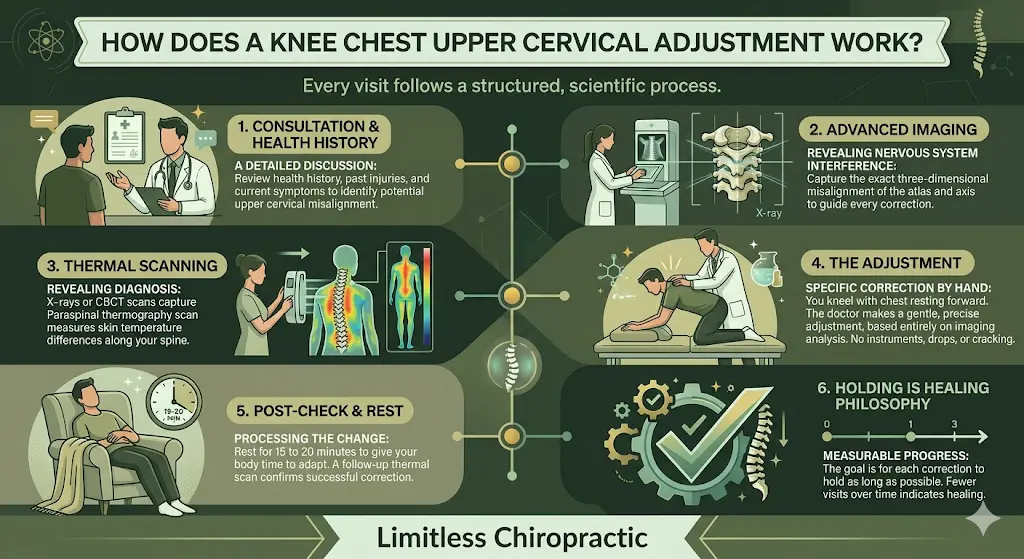
Every visit follows a structured, scientific process. Nothing is guesswork.
Consultation and Health History. Your first appointment starts with a conversation. The doctor reviews your health history, past injuries, and current symptoms. This helps identify whether an upper cervical misalignment could be the root cause of your problems.
Advanced Imaging. Precision X-rays or CBCT (Cone Beam CT) scans capture the exact three-dimensional misalignment of your atlas and axis. Images are taken from specific angles so the doctor can see the problem from every direction. This imaging guides every correction.
Thermal Scanning. A paraspinal thermography scan measures skin temperature differences along your spine. This reveals nervous system interference. The technology traces back to Pattern System Analysis, a diagnostic method Palmer developed in the 1930s that practitioners still use today.
The Adjustment. You kneel on a padded table with your chest resting forward. The doctor delivers a precise, quick correction by hand. There are no instruments. No drop pieces. No twisting or cracking. The force is gentle but specific, based entirely on your imaging analysis.
Post-Check and Rest. After the correction, you rest for 15 to 20 minutes. This gives your body time to process the change. A follow-up thermal scan confirms whether the adjustment was successful.
This is where the “holding is healing” philosophy matters. The goal is for each correction to hold as long as possible. Fewer visits over time is actually a sign of progress, not a sign you need more care.
Why Knee Chest Is Different from Other Upper Cervical Techniques
Upper cervical chiropractic includes several distinct methods. Each one aims to correct misalignments at the top of the spine. But the Knee Chest Upper Cervical technique stands apart for a few specific reasons.
| Factor | Knee Chest | NUCCA | Blair | Atlas Orthogonal | Toggle Recoil |
| Method | Hands only | Hands only | Hands only | Instrument | Hands + drop |
| Instruments Used | None | None | None | Percussion stylus | Drop headpiece |
| Corrects C2 | Yes | Varies | Varies | Rarely | Varies |
| Mission Portable | Yes | No | Limited | No | Limited |
| Mastery Difficulty | Highest | High | High | Moderate | High |
Three things set the Knee Chest approach apart from every other method:
It’s entirely hands-on. There are no instruments, drop pieces, or mechanical tools. The correction depends completely on the doctor’s skill and precision. That’s why it’s widely considered the most difficult upper cervical technique to master.
It corrects both C1 and C2. Many upper cervical methods focus only on the atlas. The Knee Chest technique addresses the axis too. For some patients, a C2 misalignment is actually the root cause behind the atlas problem.
It works in resource-limited settings. Knee Chest is the only upper cervical technique that can be performed during international mission trips without specialized equipment. That’s one reason why KCUC practitioners regularly serve communities in places like Haiti and the Dominican Republic.
What Conditions Can the Knee Chest Technique Help?
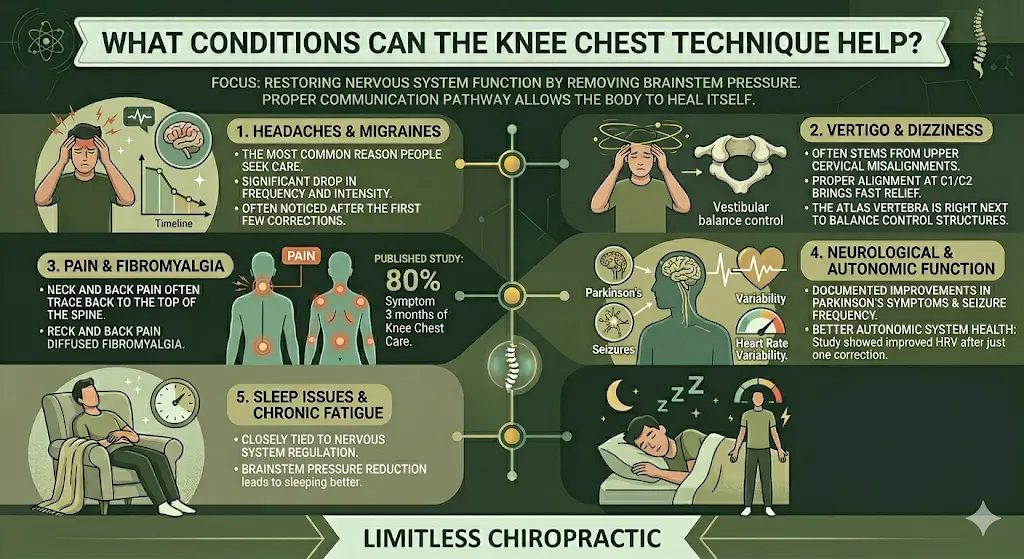
The Knee Chest approach doesn’t chase symptoms. It focuses on removing pressure from the brainstem so your nervous system can function properly. When that communication pathway is clear, the body can heal itself.
Patients who receive upper cervical care in Charlotte, NC have reported improvements in a wide range of conditions:
Headaches and migraines are the most common reason people seek this care. Many patients notice a significant drop in frequency and intensity after their first few corrections.
Vertigo and dizziness often stem from upper cervical misalignments. The atlas sits right next to the structures that control balance, so proper alignment can bring fast relief.
Neck pain, back pain, and fibromyalgia frequently trace back to a problem at the top of the spine. A published case study in the Journal of Upper Cervical Chiropractic Research documented 80 percent symptom relief in a fibromyalgia patient after three months of Knee Chest care.
Neurological concerns have also responded to this technique. Peer-reviewed studies published in journals like JVSR and JMPT have documented improved Parkinson’s symptoms, reduced seizure frequency, and better quality of life following Knee Chest adjustments. A separate study showed improvements in heart rate variability (HRV), a key marker of autonomic nervous system health, after just one correction.
Sleep issues and chronic fatigue are closely tied to nervous system regulation. When brainstem pressure is reduced, many patients report sleeping better and waking with more energy.
What to Expect During Your First Knee Chest Upper Cervical Visit
Walking into any new doctor’s office can feel uncertain. Here’s what your first visit at Limitless Chiropractic looks like, step by step.
You’ll start with a one-on-one conversation about your health history. The doctor wants to understand your symptoms, past injuries, and goals. Next, precision imaging captures the exact position of your upper cervical spine. A thermal scan measures how well your nervous system is functioning.
If a misalignment is found, you’ll receive your first gentle correction. Afterward, you’ll rest while your body processes the change. A follow-up scan confirms the results before you leave.
Worried about pain? Most patients say the adjustment feels lighter than they expected. You may feel slight movement or hear a small sound. That’s completely normal and safe.
This care works for patients of all ages. Children, teenagers, adults, and seniors have all benefited from the Knee Chest Upper Cervical technique. Meet the chiropractic team at Limitless Chiropractic to learn more about their approach.
Frequently Asked Questions About the Knee Chest Upper Cervical Technique
Is the Knee Chest adjustment painful?
No. The correction is gentle and precise. Most patients report it feels much lighter than they expected. You may feel slight movement or hear a small sound, which is normal and safe.
How is the KCUC technique different from regular chiropractic?
Regular chiropractic often adjusts multiple areas of the spine in one visit. The Knee Chest technique focuses only on the top two bones, the atlas (C1) and axis (C2), using advanced imaging and thermal scanning for pinpoint accuracy. There is no twisting, popping, or cracking.
How many adjustments will I need?
Every patient is different. The goal is for each correction to hold as long as possible. Many patients need fewer visits over time because the body heals best when the alignment stays in place.
Can children receive Knee Chest adjustments?
Yes. The technique is gentle enough for patients of every age, including infants, young children, and seniors.
Why are there so few certified KCUC practitioners?
The Knee Chest technique is widely considered the most difficult upper cervical method to master. It requires extensive hands-on training with no instruments or mechanical tools. Certification demands demonstrated proficiency verified through spinal thermography.
What does “holding is healing” mean?
It means the correction is designed to stay in place. When the atlas holds its proper alignment, the body heals on its own without repeated adjustments. Fewer visits over time is actually a sign of progress.
Schedule Your Knee Chest Upper Cervical Consultation in Charlotte, NC
The Knee Chest Upper Cervical technique is one of the most precise and effective approaches in chiropractic care. It targets the root cause of nervous system interference rather than masking symptoms with repeated adjustments.
Dr. Tim Hartman at Limitless Chiropractic in Charlotte, NC is one of the few certified instructors in the world for this technique. His training lineage traces directly back to the founder, Dr. B.J. Palmer. His credentials, mission work, and global teaching impact place him among the most qualified Knee Chest practitioners anywhere.
If you’re ready to find out whether an upper cervical technique in Charlotte, NC could help you, call 704-765-0454 today to schedule your consultation. Your body has the power to heal. Sometimes it just needs the right correction to start.